
Shock buffet limits aircraft efficiency, performance, and operational safety in transonic flight. Using exascale CFD and high-fidelity simulations, CEEC demonstrated how next-generation modeling can improve buffet prediction, support lighter wing designs, and accelerate the development of more efficient aircraft.
| Industry | Scientific Domain | Code |
| Aerospace | Aerodynamics / CFD | FLEXI/GALÆXI |
Description of the Challenge
Shock buffet undermines both flight safety and wing structure. Occurring most likely at elevated Mach numbers and increased load factors where wing angle of attack and shock strength are increased, it consists of the formation of supersonic pockets of air that are terminated by normal shock waves that oscillate along the chord, resulting in massive flow disruption and a localized loss of lift. This shock buffet induces high dynamic loads on the wings, a highly unsteady wake, and increased structural fatigue, particularly under sustained operation near buffet boundaries. It becomes a significant limiting factor in the transonic regime, typically around Mach 0.80–0.95 for many transport aircraft, and is especially critical at high altitudes, where the margins between low-speed and high-speed buffet boundaries narrow.
Since buffet (among other factors) defines the Maximum Operating Machand altitude ceiling of an aircraft, the current requirements from certification authorities (like the FAA or EASA) to ensure safety during turbulence or maneuvers often forces aircraft to fly slower than their theoretical optimal speed, increasing fuel burn and trip time. Consequently, understanding and reliably predicting shock buffet, the task of lighthouse case 1 (LHC1), is critical for safety, efficiency, and especially the success of new aircraft design concepts as we discuss below.
Furthermore, similar shock-induced separation phenomena are also important in turbomachinery design. In high-pressure compressors, shock–boundary-layer interactions can contribute to compressor stall and surge. While practical blade design remains constrained by structural requirements, thermal loading, erosion resistance, and manufacturing considerations, improved high-fidelity flow modeling enables optimization of blade geometries and can help delay shock-induced flow separation, thereby also potentially improving compressor efficiency and stability margins.
Why this Matters for Industry
Current industry-standard computational tools continue to struggle with accurately predicting shock buffet in transonic flight regimes because industrial aerodynamic design workflows largely rely on Reynolds-Averaged Navier–Stokes (RANS) and Unsteady Reynolds-Averaged Navier–Stokes (URANS) methods. While these methods offer an attractive balance between computational cost and accuracy, they often struggle to capture the complex, non-equilibrium turbulence associated with shock-induced separation and shock–boundary-layer interactions. As a result, RANS- and URANS-based simulations may exhibit significant uncertainties in predicting buffet onset, shock motion, load amplitudes, and dominant oscillation frequencies. These limitations become particularly pronounced near the buffet boundary, where small changes in flow physics can strongly influence aerodynamic loads and aircraft performance.
To compensate for these uncertainties, industrial design processes either rely heavily on validation and correlation against experimental data obtained from wind-tunnel and flight-test campaigns, or being unable to accurately predict buffet loads forces engineers to “over-design” wings with extra weight and reinforcement to survive the “worst case scenario” fatigue, further increasing fuel consumption. Hence, current modelling and development cycles are only successful for conventional aircraft configurations while significantly hindering new wing designs, leaving significant aircraft performance and fuel efficiency on the table.
High-fidelity simulation approaches have the potential to reduce predictive uncertainty, improve confidence in design decisions, and support the development of lighter wing structures. This directly facilitates fuel burn reduction since every kilogram saved in wing weight translates directly to a reduction in fuel consumption.
Nevertheless, buffet is only one of many phenomena that drive engineering conservatism in aerospace design. Other considerations, including aeroelastic flutter, gust loading, damage tolerance requirements, fatigue certification, manufacturing variability, and fail-safe design principles, also necessitate substantial design margins. As a side note, some of these concerns are addressed by our Lighthouse Case 2 aeroelastic simulation use case.
Ultimately, improvements in buffet prediction alone are unlikely to produce dramatic reductions in overall structural safety margins, but they can provide meaningful gains in aerodynamic performance, structural efficiency, maintenance planning, and overall lifecycle cost.
▶ Scientific Background
At the level of fundamental flow physics, improved simulation of three-dimensional shock buffet can help reveal the mechanisms governing shock-boundary layer interactions in three-dimensional flows such as those found on wings and in axial compressors. Compared to RANS and URANS methods, which model turbulence statistically and may underpredict or misrepresent unsteady shock motion, high-fidelity approaches such as large eddy simulation (LES) and hybrid RANS/LES methods can better resolve the unsteady dynamics and spectral content associated with buffet phenomena.
From a simulation science perspective, these approaches provide an opportunity to develop and validate more reliable numerical models for separated, non-equilibrium flows at high Reynolds numbers relevant to aerospace applications ($Re >> 10^6$). RANS and URANS methods remain computationally efficient at realistic flight Reynolds numbers because they model the averaged effects of turbulence rather than resolving turbulent scales directly. However, their predictive accuracy can be limited in regimes where unsteady shock-boundary layer coupling dominates the flow physics. In contrast, high-fidelity methods such as wall-resolved LES (WRLES) are computationally prohibitive for full aircraft configurations at flight Reynolds numbers due to the extremely fine near-wall resolution required to capture boundary layer turbulence. As a result, practical high-fidelity simulations at relevant Reynolds numbers typically rely on wall-modeled LES (WMLES) or hybrid RANS-LES approaches, which reduce near-wall resolution requirements while attempting to retain key unsteady flow features. This is achieved by applying RANS closure or specialized algebraic, differential, or data-driven wall-models exclusively in the inner, attached boundary layer. These wall-models bypass the punishing grid-resolution constraints of the innermost viscous sublayer by calculating the wall shear stress through analytical wall functions rather than direct resolution. Conversely, away from the wall, the formulation switches to a pure LES. Because the computational mesh does not need to resolve the microscopic near-wall eddies, computational resources can be focused entirely on directly computing the large-scale, time-dependent vortex shedding and shock-induced separation dynamics.
With advances in exascale computing and GPU acceleration, LHC1 extends the applicability of high-fidelity methods toward more complex, higher Reynolds number configurations than previously feasible. This includes improved representation of unsteady shock dynamics and separation behavior in geometries representative of modern wings and compressor cascades. These high-fidelity simulations are typically validated against experimental data from wind-tunnel testing, enabling quantitative assessment of their ability to predict key metrics such as lift-break characteristics, buffet onset boundaries, and unsteady frequency spectra. Such validation is essential to bridge the gap between qualitative flow visualization and quantitative prediction of aerodynamic and structural loads.
In the longer term, continued improvements in high-fidelity simulation capability, combined with experimental validation and reduced-order modeling, may reduce reliance on late-stage design corrections and help shift aerodynamic development toward a more simulation-driven workflow, although wind-tunnel and flight testing will remain essential for certification and final verification for the foreseeable future.
▶ Technical Details: Exascale Computing Approach
Accurately capturing shock buffet necessitates a spectrum of high-fidelity computational strategies ranging from computationally intensive WRLES to more efficient WMLES. In this hierarchy, WRLES serves as the indispensable standard for quantifying the accuracy of wall models later used in WMLES. However, as simulations move towards realistic 3D buffet scenarios, even WMLES requires grid resolutions exceeding several billion degrees of freedom and the capacity of industrial systems. Rather, such scales demand the utilization of tens of thousands of GPUs, often requiring full-machine execution on the world’s largest supercomputers.
The computational challenge of modelling shock buffet is further compounded by the temporal requirements of simulation times long enough to capture a sufficient number of buffet cycles to resolve meaningful frequencies and statistical averages of shock oscillations. To meet these computational and temporal demands, the entire simulation toolchain was made exascale ready, encompassing all phases from pre- to post-processing. Within this workflow, the CPU-based architecture of the open-source, high-order CFD solver FLEXI was ported to GPUs, resulting in the accelerated framework GALÆXI to fully exploit modern hardware accelerators. This transformation provides a flexible, heterogeneous framework optimized for efficient execution across both CPU- and GPU-based high-performance computing architectures. By leveraging these next-generation environments, GALÆXI enables high-fidelity simulations of shock buffet at realistic Reynolds numbers and significant spanwise extensions, computational tasks previously deemed prohibitive due to infeasible runtimes.
Results and New Insights
The application of the high-fidelity FLEXI/GALÆXI framework to LHC1 (3D shock buffet) has offered the following insights and outcomes:
- The high-fidelity approach demonstrated a marked increase in the accuracy of buffet onset prediction. By leveraging non-equilibrium WMLES, the framework successfully resolved the complex local flow physics, accurately capturing the corresponding lift curves and buffet frequency. While the transient features of the flow can be reproduced experimentally and numerically using high-fidelity LES, lower-order methods typically dampen these critical dynamics. The non-equilibrium WMLES framework bridges this gap by mitigating such dampening effects while permitting the execution of significantly longer buffet cycles to establish robust, time-averaged statistics.
- The simulations reinforced the established understanding of buffet physics, specifically confirming that pressure fluctuations at the trailing edge are the primary drivers that trigger and sustain shock oscillations. While the core mechanism of shock buffet remains consistent with known theory, the use of both WRLES and WMLES provided a clearer window into how these fluctuations propagate upstream through the subsonic portion of the boundary layer to interact with the shock. This high-resolution data confirms that accurately capturing the trailing-edge noise and separation is non-negotiable for any solver intended to predict buffet onset.
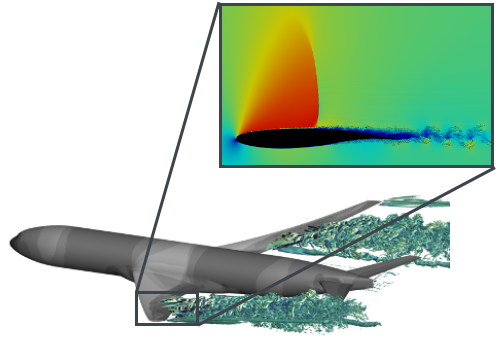
This two-part visualization offers a multi-scale perspective on the aerodynamic complexities of transonic flight. The primary image, derived from a Detached Eddy Simulation (DES), captures the macro-scale flow field of the NASA Common Research Model (CRM), specifically highlighting the massive blue-green turbulent vortices shedding from the wing’s trailing edge. Complementing this, the inset utilizes WRLES to provide a micro-scale view of the pressure field on a wing cross-section, where the boundary layer is resolved down to the smallest energy-dissipating eddies. The pressure gradient spans from high-pressure stagnation points at the leading edge (red) to intense low-pressure regions (blue) within the turbulent structures.
As the flow progresses along the chord, the WRLES transition from a laminar to a turbulent boundary layer is visible. The onset of separation is marked by distinct, small-scale vortical structures—visualized as localized circular low-pressure zones—which engage in a continuous, non-linear feedback loop with an oscillating shock wave. This interaction characterizes the shock buffet phenomenon. The coherence of these structures is further tracked into the wake, where the low-pressure “cells” in the WRLES correspond directly to the cross-sections of the larger vortices captured in the global DES. By resolving both the high-frequency turbulent fluctuations at the wall and the lower-frequency global oscillations, the high-fidelity simulation provides a complete chain of causality: it reveals not just that the shock is moving, but exactly how microscopic turbulent structures are driving that movement, revealing – though not obviously – that buffet is not a simple, single-frequency oscillation. Instead, it uncovers complex secondary high-frequency dynamics triggered by the shock’s interaction with individual sub-cell vortices. Capturing this chaotic feedback is the only way to reliably design future wing configurations.
While DES is effective for capturing large-scale wake structures, it generally lacks the resolution to capture the intricate near-wall phenomena shown in the inset. DES cannot capture these fine-grained shock-turbulence boundary-layer interaction phenomena as accurately as WRLES, as it typically relies on RANS modeling near the surface, which tends to over-dampen the sensitive interaction between the shock and the turbulent boundary layer. The high-fidelity WRLES captures the spectral energy transfer between the shock and the small-scale eddies. This detail is essential for predicting the exact point of buffet breakout where vibrations transition from mild to structurally hazardous, allowing engineers to quantify dynamic structural loads with a degree of mathematical certainty unattainable by time-averaged models.
While DES is effective for capturing large-scale wake structures, it generally lacks the resolution to capture the intricate near-wall phenomena shown in the inset. DES cannot capture these fine-grained shock-turbulence boundary-layer interaction phenomena as accurately as WRLES, as it typically relies on RANS modeling near the surface, which tends to over-dampen the sensitive interaction between the shock and the turbulent boundary layer. The high-fidelity WRLES captures the spectral energy transfer between the shock and the small-scale eddies. This detail is essential for predicting the exact point of buffet breakout where vibrations transition from mild to structurally hazardous, allowing engineers to quantify dynamic structural loads with a degree of mathematical certainty unattainable by time-averaged models.
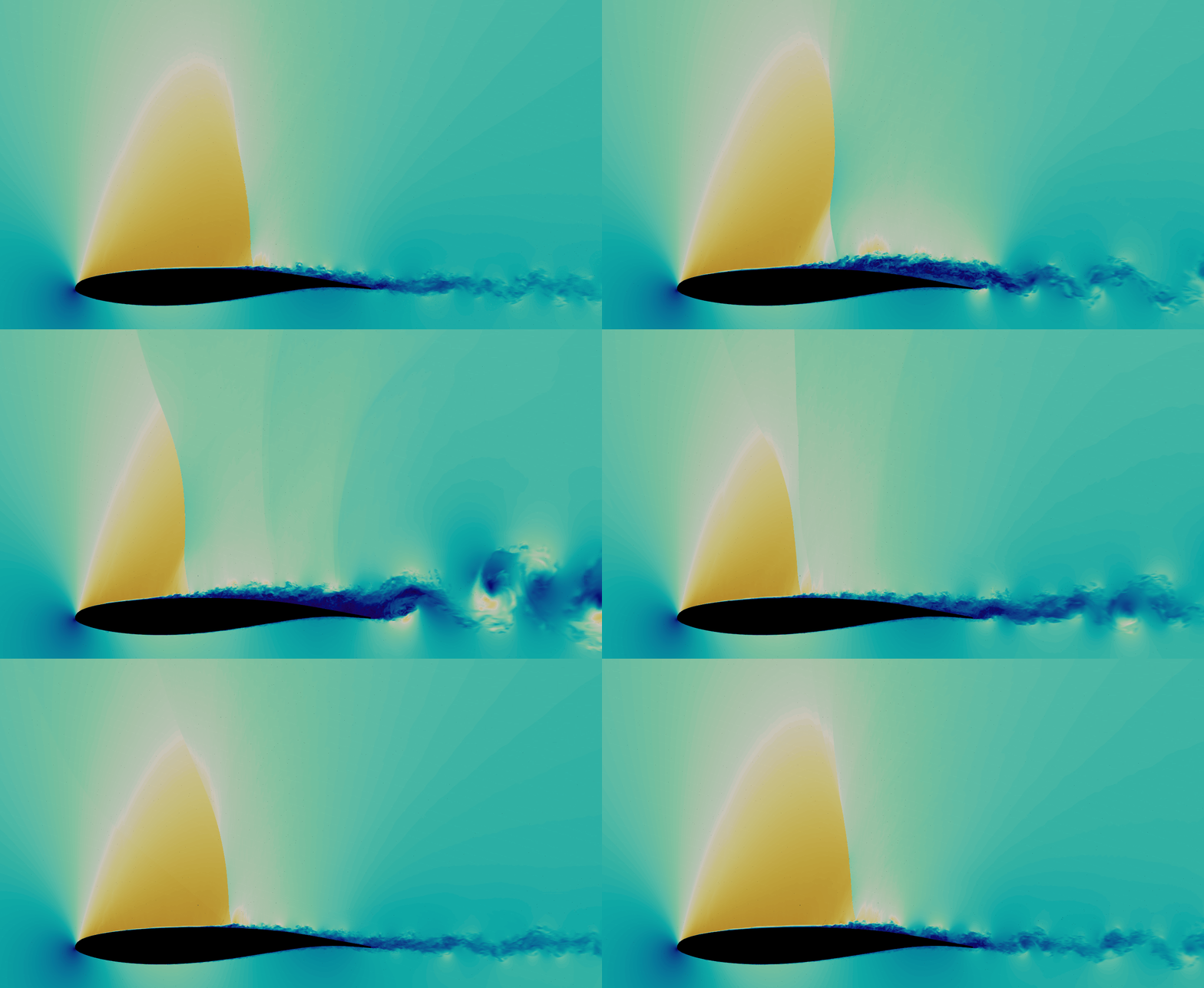
Using the high-fidelity datasets generated by these simulations can support refinement of data-driven wall models. Given that WRLES remains computationally intensive for routine industrial use, the detailed flow physics extracted from these simulations provide a valuable foundation for calibrating more sophisticated wall-modelling closures that can generate more accurate representations of near-wall dynamics within a WMLES or hybrid RANS/LES framework. This data reuse can thus offer a more accessible pathway to incorporating high-fidelity insights into the standard engineering design loop.
Industrial Takeaways
The presented modelling framework offers several distinct practical benefits for industrial application. By leveraging non-equilibrium WMLES, the architecture provides a marked improvement in the prediction of shock buffet onset for transonic wings. Furthermore, these high-fidelity insights enable the enhanced calibration of standard industrial CFD tools through rigorous, physics-based validation of existing RANS and URANS turbulence models. In addition, the framework enables the development of calibrated surrogate models that combine the high-fidelity accuracy of exascale simulations with the computational efficiency required for routine engineering design.
Ultimately, improving the reliability of shock-buffet prediction contributes to accelerated development timelines and reduced emissions over the lifecycle of the aircraft by enabling lighter, optimized wing architectures with expanded operational envelopes and extended fatigue life. While improvements in high-fidelity simulation capability, and reduced-order modelling will increasingly drive this early aerodynamic development and mitigate late-stage design corrections, wind-tunnel and flight testing remain indispensable for final certification and verification.
▶ Codes and Software Stack
FLEXI
FLEXI and its GPU version GALÆXI are highly scalable open-source codes designed for the simulation of complex compressible flows based on the high-order accurate discontinuous Galerkin spectral element method (DGSEM). Engineered to meet modern high-performance computing demands, these frameworks enable the simulation of complex turbulent flow problems across heterogeneous computing systems.
Its key characteristics include:
- Providing the high-fidelity resolution required for DNS, WRLES and WMLES of turbulent phenomena by leveraging the DGSEM. High-order accuracy is particularly critical for shock-boundary layer interactions. Unlike low-order methods that often smear shocks and dissipate fine-scale turbulence, the DGSEM framework preserves the integrity of small-scale eddies. This is essential for capturing the correct frequency and amplitude of shock oscillations in buffet scenarios.
- Utilizing a localized finite volume sub-cell scheme to ensure stability near discontinuities. By switching to a robust FV solver only within elements containing a shock, the code maintains high-order precision elsewhere, strictly isolating numerical dissipation to the shock front.
- Simulating shock buffet at realistic high-Reynolds numbers enabled by advanced wall-modelling capabilities, which significantly reduce the grid requirements at the wall.
- High scalability on modern HPC systems, including GPU-accelerated architectures
- Vendor-agnostic performance portability across different supercomputing platforms
Lastly, the open-source nature of the code facilitates further development and potential adoption by both academic and industrial users.