• Enabling mixed-precision with VerifiCarlo: Sharing CEEC experience

    Driven by the increasing need to reduce the energy consumption of computing centers and simulations, scientists have begun revising applications, algorithms, and their underlying working/storage precision not just for performance but also for energy efficiency. The goal is to make computational costs sustainable while adhering to the lagom principle—using precision that is “just right” to balance accuracy with efficiency. However, before lowering precision, one must ensure that the simulation is numerically correct. Verificarlo is an open-source framework designed to verify and optimize numeric aaccuracy in complex programs. In this webinar, we will introduce Verificarlo, showcase its backends for numerical bug detection and mixed-precision analysis, and present a success story highlighting the road from analysis of codes with Verificarlo to reliable mixed-precision codes.

  • 3rd CEEC Community Workshop – Vistle Part II: Hands-On Workshop for 3D Data Visualization

    HLRS University of Stuttgart Nobelstraße 19, Stuttgart, Germany

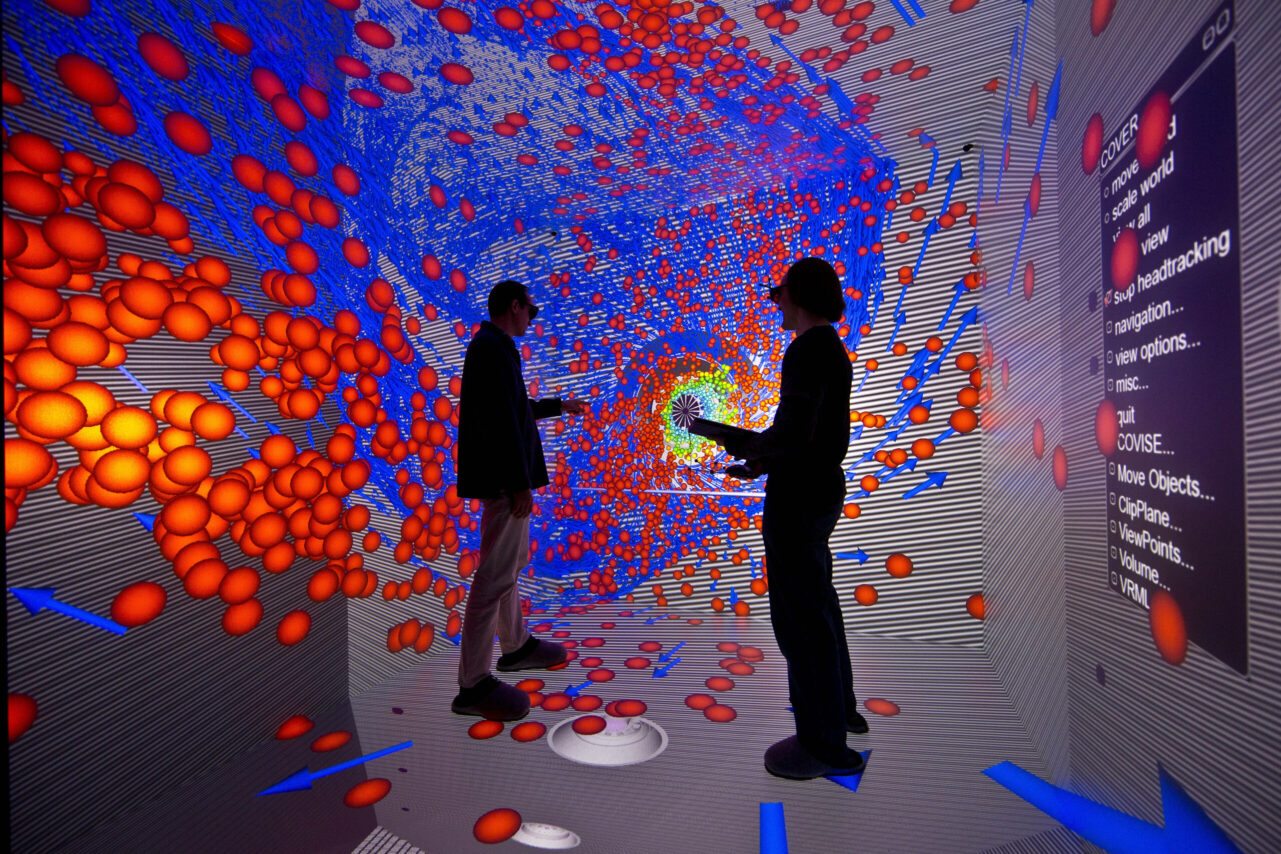
    In this hands-on two-hour workshop, you’ll get to know Vistle, a powerful open-source visualization tool, and learn how to create compelling 3D representations of scientific datasets, both in desktop as well as Virtual Reality environments. After an introduction to the software and its key features, you’ll have the opportunity to apply your knowledge and create your own visualization.

  • Mixed-Precision and Energy-Efficient Computations

    Join Yanxiang Chenat ISC in the Foyer D-G – on the 2nd floor to learn about our latest work using mixed precision to reduce energy consumption without compromising accuracy.

  • CEEC at ISC25

    Join our own Niclas Jansson at the Euro HPC JU booth for a presentation on our project and progress so far!

  • RESEARCH POSTER PITCH with Yanxiang Chen

    After listening to Niclas Jansson present our project at the EuroHPC JU booth at 1pm, strole over to Hall E to hear from our own Yanxiang Chen. If you want […]

  • Fully-resolved LBM-DEM simulations of piping erosion during a suction bucket installation

    Arcrea HIMEJI 143-2, Kamiyacho, Himeji-City, Hyogo, Japan

    Join our Samuel kemmler for his talk at the 10th International Conference on Discrete Element Methods (DEM10) this summer in Himeji, Japan !

    Suction bucket foundations are a cost-efficient and environmentally sustainable method for installing offshore wind turbines, however, they can fail because of piping erosion, when fluidization of particles beneath the bucket wall tip causes a drop in suction pressure. Unfortunately, the mechanisms of piping erosion are insufficiently understood. Hence, a three-dimensional, fully-resolved coupled LBM-DEM simulation is employed to conduct an in-depth analysis of piping erosion to identify key influencing parameters and enhance understanding and optimisation of the installation process. Results from simulations executed on hundreds of GPUs on the LUMI supercomputer are presented, illustrating the method’s capability to tackle this complex challenge.

  • Introduction to the DLB Library and Measuring GPU performance

    Online

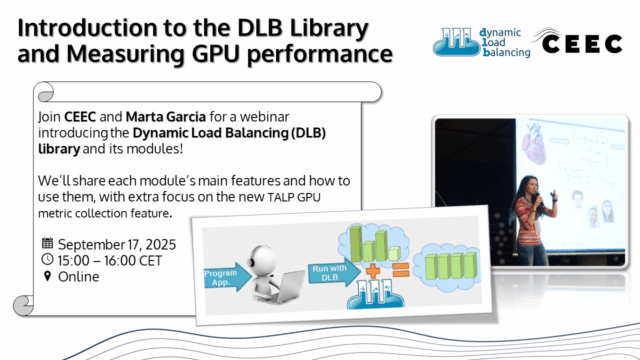
    In this webinar we’ll provide an overview of the DLB library and each one of its modules. For each module we’ll share its main features, how to use it, and some success stories. We’ll put special focus on the TALP module and its recent extension to provide GPU metrics when getting performance measurements.