
This past May was an especially busy month for the Center of Excellence in Exascale CFD (CEEC). While our all-hands meeting was underway at HLRS, CEEC experts were also actively participating in the “Porting and Optimization for Hunter” Hackathon—an intense coding event designed to help research teams prepare their applications for HLRS’s next-generation supercomputer, Hunter, based on AMD MI300A accelerated processing units (APUs).
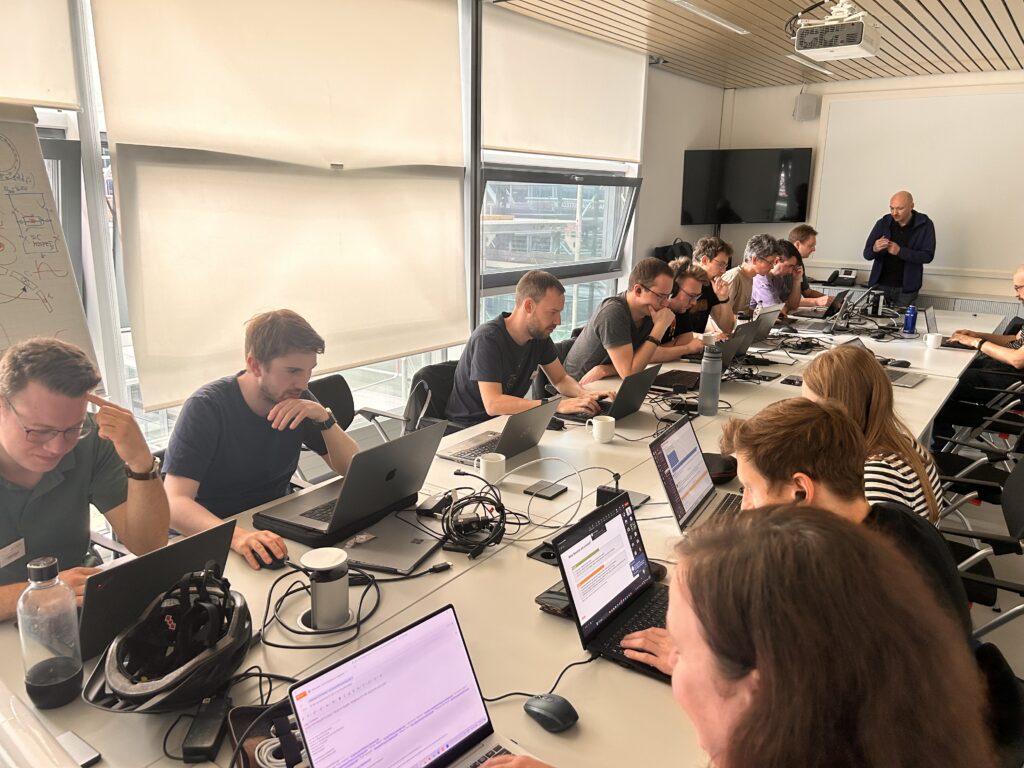
The hybrid hackathon, held from May 19–23 with a virtual preparation session on May 9, supported selected user groups in porting and optimizing their codes for the new system, with a strong focus on GPU offloading. Participants worked closely with specialists from HLRS, HPE, and AMD to analyze code performance, choose appropriate programming models (such as HIP or OpenMP offloading), and offload compute-intensive kernels to the GPU part of the APU.
“Regardless of the vendor/host, the hackathons are always a benefit because of the hands-on work with experts. Working with the AMD people directly and learning how to use the AMD profiling tools in a detailed way was easily the biggest takeaway from the week (even more than the performance increases).” – Spencer Star, Institute of Aerodynamics and Gas Dynamics
The CEEC team focused on optimizing the GALÆXI CFD code, working hands-on with AMD’s profiling tools omniperf and rocprof to identify performance bottlenecks. More than ten compute kernels were optimized, resulting in individual kernel performance improvements of up to 20%. The hackathon culminated in a successful full-system run of GALÆXI across all 148 available nodes on Hunter with an overall performance improvement of over 35% on the MI300A hardware.
This hackathon, like MnHack in November 2024, was part of the ongoing work CEEC is doing to advance exascale-ready computational fluid dynamics and scientific computing on Europe’s most powerful HPC platforms. As best summarized by Spencer Starr, part of the FLEXI team from the Institute of Aerodynamics and Gas Dynamics, “Regardless of the vendor/host, the hackathons are always a benefit because of the hands-on work with experts. Working with the AMD people directly and learning how to use the AMD profiling tools in a detailed way was easily the biggest takeaway from the week (even more than the performance increases).”