
Tag: Parallel Programming Languages
-
Performance Portability for Fortran Software – Experience from GALÆXI
On 9 December 2025, we wrapped up our webinar programme for the year with a session focused on a timely challenge across high-performance computing: how to prepare long-standing Fortran simulation codes for today’s GPU-based systems. In this final webinar of 2025, our own Spencer Starr shared insights from the Numerics Research Group at the Institute…
-
Performance Portability for Fortran CFD Software with GALÆXI
With GPU acceleration now ubiquitous in HPC, porting existing simulation software to leverage GPUs is more important than ever. Although many GPU programming models exist, they often have limited or no support for Fortran, making porting existing Fortran scientific codes to multiple computing architectures an extra struggle. This webinar guides you through one solution of…
-
FLEXI: Scale-resolving simulations of compressible turbulence on modern HPC systems
Join our own Anna Schwarz for the WHPC Europa invited session discussing our latest work preparing FLEXI for exascale and GPU-based systems.
-
Two Years of CEEC & EPI
CEEC’s co-design efforts with the European Processor Initiative (EPI) target performance portability for European vector hardware. Using real CFD codes, the team provides feedback to hardware, compiler, and application developers, shaping the EPAC accelerator for scientific computing.
-
CEEC at the Hunter Hackathon: Optimizing CFD for AMD MI300A APU-Based Systems
At HLRS’s Hunter Hackathon, CEEC teams joined forces with AMD, HPE, and HLRS experts to prepare the GALÆXI CFD code for Hunter, the center’s next-gen APU-based system. The hands-on guidance and deep dives into profiling tools yielded wins both in knowledge and performance.
-
Introducing Yanxiang Chen
My name is Yanxiang Chen, a second-year PhD student at Umeå University in Sweden. With a background in computational mathematics, I went on to do a master’s degree at Trinity College Dublin, where I began to build systematic knowledge in parallel computing. After graduation, I had the opportunity to work at the Supercomputing Center in…
-
Programming complex workflows with PyCOMPSs
On December 16th, CEEC and our own Rosa Badia presented our latest webinar. During the one-hour webinar, attendees learned about the history, goals, and capabilities of PyCOMPSs in the context of increasingly diverse and heterogenous HPC systems across Europe. Then, Rosa presented example workflows both related to CEEC and from outside the project including links…
-
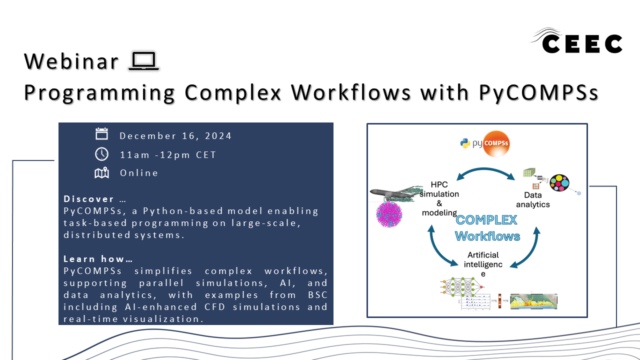
Programming complex workflows with PyCOMPSs
Programming large-scale systems poses several challenges to scientific application developers. Join us for a webinar on PyCOMPSs, a pioneering approach to task-based programming in Python that enables codes to be executed in distributed computing platforms. This webinar will give an overview of PyCOMPSs illustrated with examples in development at BSC that include CFD simulations with…
-
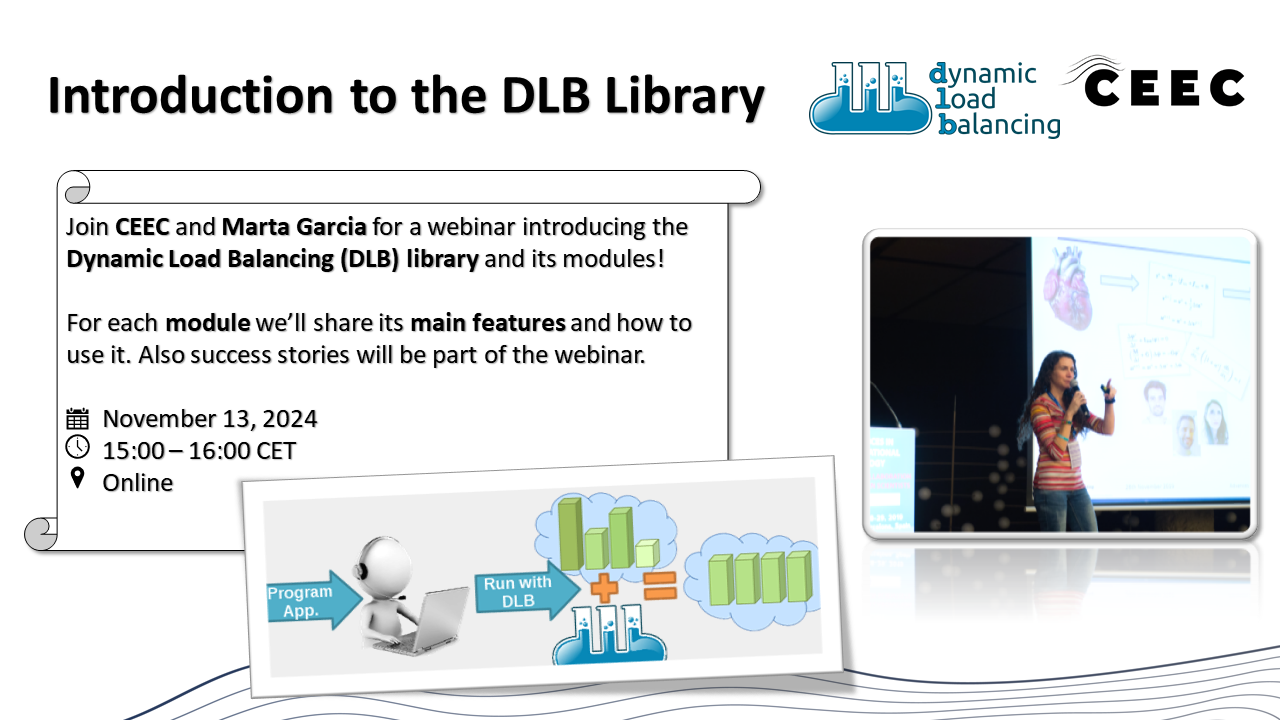
Introduction to the DLB Library
The Dynamic Load Balancing library is a runtime library that offers different capabilities to HPC users. It consists of three different modules that work collaboratively and independently: • Lend When Idle (LeWI) • Tracking Application Life Performance (TALP) • Dynamic Resource Ownership Management we will provide an overview of the DLB library and each one…
-
CEEC and the European Processor Initiative: An Explainer Podcast Episode
Check out the latest in our explainer series, this time in the form of a podcast episode from the newly rleased Supercomputing in Europe series!