• Sustainable and Reliable Computing with Tools: Analyzing Precision Appetites of CFD Applications with VerifiCarlo

    Energy consumption constraints for large-scale computing encourage scientists to revise the architecture design of hardware but also applications, algorithms, as well as the underlying working/ storage precision. I will introduce an approach to address the issue of sustainable, but still reliable, computations from the perspective of computer arithmetic tools. We employ VerifiCarlo and its variable precision backend to identify the parts of the code that benefit from smaller floating-point formats. Finally, we show preliminary results on proxies of CFD applications.

  • VPREC to analyze the precision appetites and numerical abnormalities of several proxy applications

    The third in a series of presentations from Roman Iakymchuk on work using tools to investigate mixed precision possibilities. He and his co-author Pablo de Oliveira Castro introduce an approach to address the issue of sustainable computations with computer arithmetic tools. They use the variable precision backend (VPREC) to identify parts of code that can benefit from smaller floating-point formats and show preliminary results on several proxy applications.

  • Code of the Month vol.6 “Neko by CEEC” — PUBLIC event

    Online

    Recent trends and advancements including more diverse and heterogeneous hardware in High-Performance Computing are challenging scientific software developers in their pursuit of good performance and efficient numerical methods. As a result, the well-known maxim “software outlives hardware” may no longer necessarily hold true, and researchers are today forced to re-factor their codes to leverage these powerful new heterogeneous systems. We present Neko – a portable framework for high-fidelity spectral element flow simulations. Unlike prior works, Neko adopts a modern object-oriented Fortran 2008 approach, allowing multi-tier abstractions of the solver stack and facilitating various hard- ware backends ranging from general-purpose processors, accelerators down to exotic vector processors and Field Programmable Gate Arrays (FPGAs) via Neko’s device abstraction layer. Focusing on Neko’s performance and exascale readiness, we outline the optimisation and algorithmic work necessary to ensure scalability and performance portability across a wide range of platforms. Finally, we present performance measurements on a wide range of accelerated computing platforms, including the EuroHPC pre-exascale systems LUMI and Leonardo, where Neko achieves excellent parallel efficiency for an extreme-scale direct numerical simulation (DNS) of turbulent thermal convection using up to 80% of the entire LUMI supercomputer.

  • PLENARY: EuroHPC Users: How Are They Exploiting the Current EuroHPC Systems & Will Exploit Future Exascale Capabilities?,

    Flanders Meeting and Convention Centre, A Room with a ZOO Koningin Astridplein 20-26, Antwerp, Belgium

    If you’re attending the EuroHPC Summit Week this month in Antwerp, make sure to join our Niclas Jansson for a PLENARY, “EuroHPC Users: How Are They Exploiting the Current EuroHPC Systems & Will Exploit Future Exascale Capabilities?”
    17:15→18:45

  • GALEXI: Scale-resolving simulations of compressible turbulence on GPU-accelerated systems

    Room 9

    Joine our Anna Schwarz for her talk “GALEXI: Scale-resolving simulations of compressible turbulence on GPU-accelerated systems”, part of the workshop “Tackling Software Exascale Challenges: the Centres of Excellence in High-Performance Computing Perspective”. She will present GALEXI, the GPU version of FLEXI, and the grogress she’s made in CEEC preparing these codes for exascale CFD simulations.

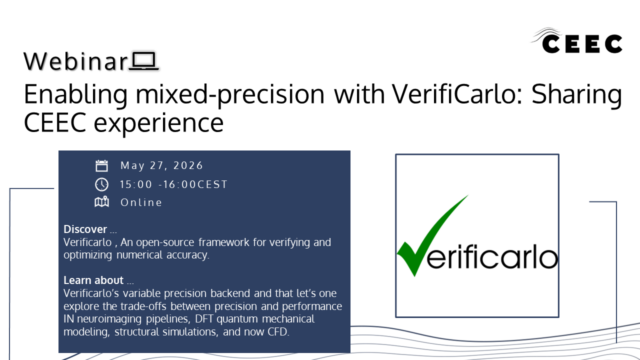
  • Enabling mixed-precision with VerifiCarlo: Sharing CEEC experience

    Driven by the increasing need to reduce the energy consumption of computing centers and simulations, scientists have begun revising applications, algorithms, and their underlying working/storage precision not just for performance but also for energy efficiency. The goal is to make computational costs sustainable while adhering to the lagom principle—using precision that is “just right” to balance accuracy with efficiency. However, before lowering precision, one must ensure that the simulation is numerically correct. Verificarlo is an open-source framework designed to verify and optimize numeric aaccuracy in complex programs. In this webinar, we will introduce Verificarlo, showcase its backends for numerical bug detection and mixed-precision analysis, and present a success story highlighting the road from analysis of codes with Verificarlo to reliable mixed-precision codes.

  • Mixed-Precision and Energy-Efficient Computations

    Join Yanxiang Chenat ISC in the Foyer D-G – on the 2nd floor to learn about our latest work using mixed precision to reduce energy consumption without compromising accuracy.

  • CEEC at ISC25

    Join our own Niclas Jansson at the Euro HPC JU booth for a presentation on our project and progress so far!

  • RESEARCH POSTER PITCH with Yanxiang Chen

    After listening to Niclas Jansson present our project at the EuroHPC JU booth at 1pm, strole over to Hall E to hear from our own Yanxiang Chen. If you want the chance to ask questions about how we’re using mixed precision to drive energy-to-solution down without compromising accuracy, make sure to stop by the research […]