Exploring Flow Fields at Scale: GPU-Accelerated Scientific Visualization for Exascale CFD
Join our own Susanne Malheiros at the WHPC Europa Invited Session to hear about our latest work on Vistle.

Join our own Susanne Malheiros at the WHPC Europa Invited Session to hear about our latest work on Vistle.
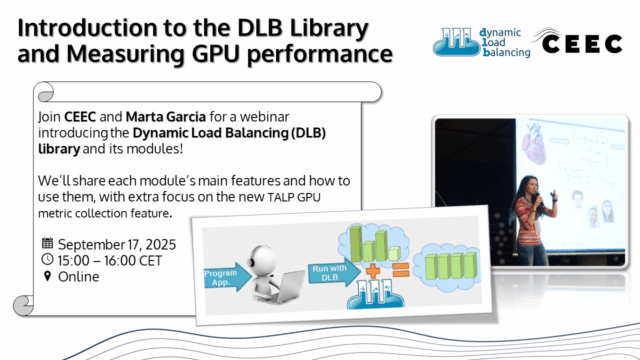
In this webinar we’ll provide an overview of the DLB library and each one of its modules. For each module we’ll share its main features, how to use it, and some success stories. We’ll put special focus on the TALP module and its recent extension to provide GPU metrics when getting performance measurements.
If you’re at the Workshop on Approximate Computing in Numerical Linear Algebra in Paris this week, don’t miss Yanxiang Chen’s lunch poster talk on mixed precision and energy efficient computations!
Then check out Roman’s talk at 14:50!
If you’re at the Workshop on Approximate Computing in Numerical Linear Algebra in Paris this week, chec out Roman Iakymchuk’s talk on mixed-precision strategies in spectral element codes on Thursday!
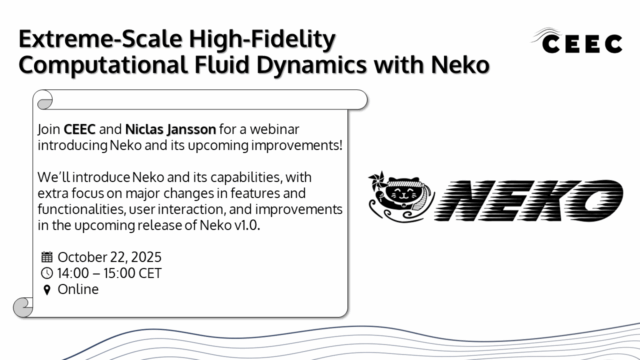
Neko is a portable framework for high-order spectral element-based simulations, mainly focusing on incompressible/compressible flow. In this webinar, CEEC’s own Niclas Jansson will provide an introduction to Neko and its capabilities, from installation to creating and running simulations. He will also focus especially on the major changes in features and functionalities, user interaction, and improvements made in the upcoming release of Neko v1.0. Join CEEC for a webinar on this 2023 ACM Gordon Bell prize finalist and get your start using Neko!

Continuous Integration and Continuous Deployment (CI/CD) are essential for sustainable and reproducible software development. This webinar provides a beginner-friendly introduction to CI/CD with a focus on the EuroHPC community. We will explore why CI/CD matters, review a selection of tools commonly used or even developed within European projects, and discuss their strengths, limitations, and typical use cases. A short example from the waLBerla project will illustrate how such workflows can be applied in practice.
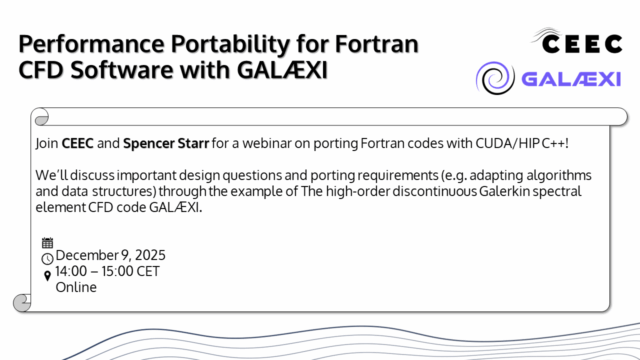
With GPU acceleration now ubiquitous in HPC, porting existing simulation software to leverage GPUs is more important than ever. Although many GPU programming models exist, they often have limited or no support for Fortran, making porting existing Fortran scientific codes to multiple computing architectures an extra struggle. This webinar guides you through one solution of taking a Fortran CFD code and porting it to GPUs using CUDA/HIP C++. We will cover the basics of GPU hardware and programming through the example of the high-order discontinuous Galerkin spectral element CFD code GALÆXI, including the important design questions and porting requirements for researchers to consider when porting their own codes.
Join Niclas Jannson in Osaka, Japan at SCA/HPCAsia2026 for his talk on “Task-decomposed Overlapped Preconditioner for Sustained Strong Scalability on Accelerated Exascale Systems.”
After the talk on preconditioners in Osaka, Japan at SCA/HPCAsia2026 , stick with Niclas Jannson for his next talk on “A Matrix-Free Algebraic hp-Multigrid Method for Computational Fluid Dynamics Application., […]
What is research software and why does it matter? These questions are the point of the first ever Research Software Day at the University of Stuttgart. Come learn about the […]