CEEC at the 1st Stuttgart Research Software Day
What is research software and why does it matter? These questions are the point of the first ever Research Software Day at the University of Stuttgart. Come learn about the […]

What is research software and why does it matter? These questions are the point of the first ever Research Software Day at the University of Stuttgart. Come learn about the […]
Engineering and science disciplines, especially computational fluid dynamics (CFD) generate massive amounts of research data, but they can only become knowledge if they can be shared and explored through data […]
Join Spencer Starr at the Society for Industrial and Applied Mathematics (SIAM)Processing for Scientific Computing (PP26)confrence in Berlin for his talk on “GALAEXI: An Architecture-Agnostic GPU-Acceleration Approach for Legacy Fortran […]
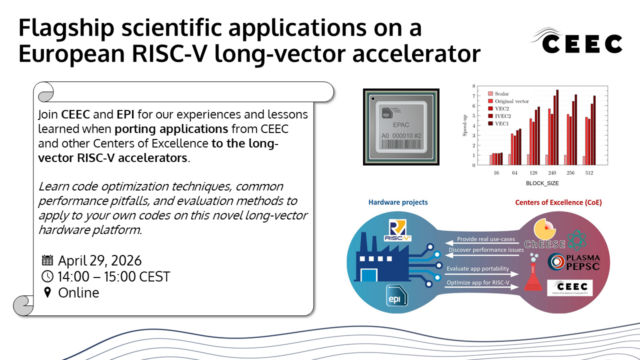
As Europe accelerates its efforts in chip sovereignty, scientific applications need to be ported to and evaluated on emerging prototypes, assessing their performance as well as the technology readiness of […]
Join our own Roman Iakymchuk, Umeå University on behalf of CEEC, and Pablo de Oliveira Castro, Université Paris-Saclay UVSQ, for our next webinar on mixed precision and VerifiCarlo!
In this webinar, we will introduce Verificarlo, showcase its backends for numerical bug detection and mixed-precision analysis, and present a success story highlighting the road from analysis of codes with Verificarlo to reliable mixed-precision codes.
Suction bucket foundations offer significant advantages for offshore wind applications, enabling fast and cost-efficient installation. However, installation failures due to piping erosion remain a critical challenge, particularly in loose or highly permeable seabeds. Understanding the interplay between seepage flow, soil properties, and foundation geometry during suction installation is essential for improving design guidelines and installation strategies. In this talk, Samuel Kemmler presents results that illustrate how fully resolved LBM-DEM modeling can complement experimental and field studies, providing a powerful tool for developing more robust suction bucket installation strategies in challenging seabed conditions.
Neko is a portable framework for high-order spectral element-based simulations, focusing primarily on incompressible and compressible fluid flows. Written using a modern object-oriented approach, the framework supports a wide range […]
Mixed-precision computing has emerged as a key strategy to improve performance and energy efficiency on current and future high-performance computing (HPC) systems. However, integrating mixed-precision into large, production-level scientific applications remains challenging due to concerns about numerical stability, accuracy, and the complexity of identifying which computations can safely tolerate reduced precision. Our results confirm that mixed-precision approaches, when carefully designed and guided by arithmetic and performance analysis, can yield significant improvements on HPC platforms for real-world scientific applications.
Join our own Niclas Jannson at the EuroHPC JU booth J30 for an overview of CEEC and our progress. You’ll have a chance to ask questions and learn what CEEC […]
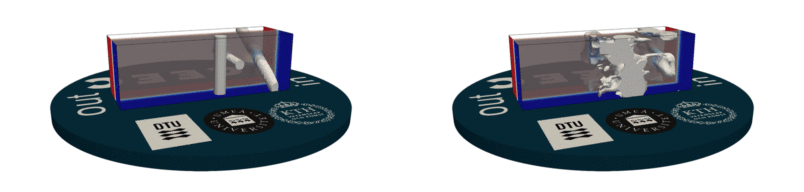
Join us in Munich for the 17th World Congress on Computational Mechanics 10th European Congress on Computational Methods in Applied Sciences and Engineering (WCCM – ECCOMAS 2026 ) for a talk called, “Adjoint Methods Using POD State Reconstructions on Modern HPC Architectures.”
Part of the mini-symposium MS349B Topology, Shape And Parameter Optimisation For Time-Dependent Systems II, the talk given by our own Harrison Nobis discusses the potential for placing checkpointing with Proper Orthogonal Decomposition to make adjoint sensitivity analysis in CFD more efficient and better suited to modern heterogeneous architectures.