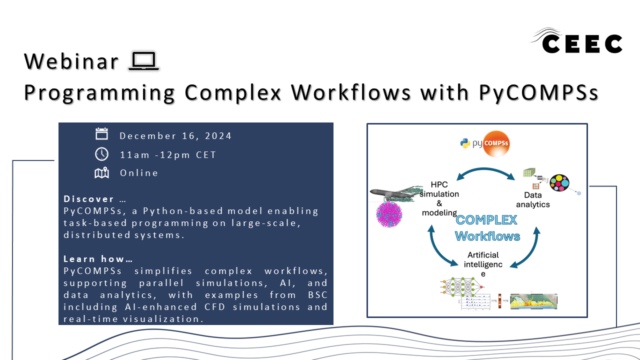
• Programming complex workflows with PyCOMPSs

    Online

    Programming large-scale systems poses several challenges to scientific application developers. Join us for a webinar on PyCOMPSs, a pioneering approach to task-based programming in Python that enables codes to be executed in distributed computing platforms. This webinar will give an overview of PyCOMPSs illustrated with examples in development at BSC that include CFD simulations with AI training or real-time visualization in the same workflow.

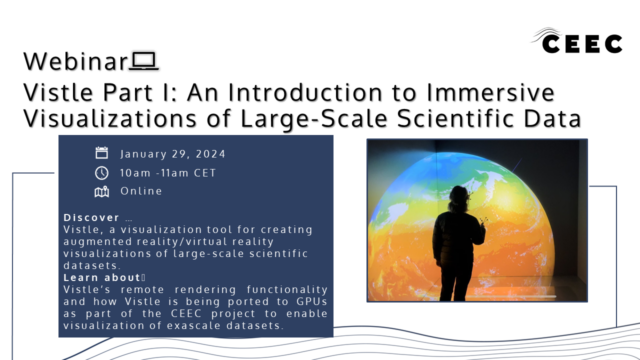
  • Vistle Part I: An Introduction to Immersive Visualizations of Large-Scale Scientific Data

    This one-hour webinar introduces the visualization tool Vistle, which is used to create augmented reality/virtual reality visualizations of large-scale scientific datasets. It presents Vistle’s remote rendering functionality and how Vistle is being ported to GPUs as part of the CEEC project to enable visualization for exascale datasets.

  • Enabling mixed-precision with VerifiCarlo: Sharing CEEC experience

    Driven by the increasing need to reduce the energy consumption of computing centers and simulations, scientists have begun revising applications, algorithms, and their underlying working/storage precision not just for performance but also for energy efficiency. The goal is to make computational costs sustainable while adhering to the lagom principle—using precision that is “just right” to balance accuracy with efficiency. However, before lowering precision, one must ensure that the simulation is numerically correct. Verificarlo is an open-source framework designed to verify and optimize numeric aaccuracy in complex programs. In this webinar, we will introduce Verificarlo, showcase its backends for numerical bug detection and mixed-precision analysis, and present a success story highlighting the road from analysis of codes with Verificarlo to reliable mixed-precision codes.

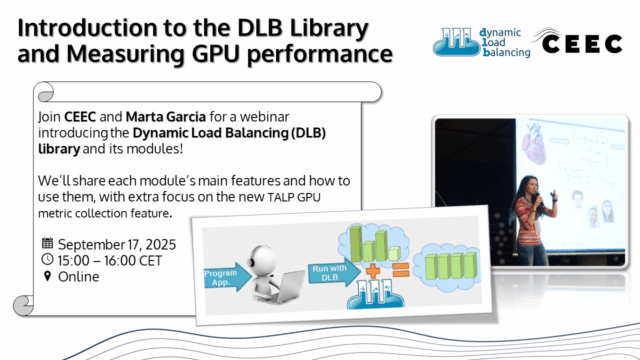
  • Introduction to the DLB Library and Measuring GPU performance

    Online

    In this webinar we’ll provide an overview of the DLB library and each one of its modules. For each module we’ll share its main features, how to use it, and some success stories. We’ll put special focus on the TALP module and its recent extension to provide GPU metrics when getting performance measurements.

  • Performance Portability for Fortran CFD Software with GALÆXI

    Online

    With GPU acceleration now ubiquitous in HPC, porting existing simulation software to leverage GPUs is more important than ever. Although many GPU programming models exist, they often have limited or no support for Fortran, making porting existing Fortran scientific codes to multiple computing architectures an extra struggle. This webinar guides you through one solution of taking a Fortran CFD code and porting it to GPUs using CUDA/HIP C++. We will cover the basics of GPU hardware and programming through the example of the high-order discontinuous Galerkin spectral element CFD code GALÆXI, including the important design questions and porting requirements for researchers to consider when porting their own codes.