• Performance Portability for Fortran CFD Software with GALÆXI

    Online

    With GPU acceleration now ubiquitous in HPC, porting existing simulation software to leverage GPUs is more important than ever. Although many GPU programming models exist, they often have limited or no support for Fortran, making porting existing Fortran scientific codes to multiple computing architectures an extra struggle. This webinar guides you through one solution of taking a Fortran CFD code and porting it to GPUs using CUDA/HIP C++. We will cover the basics of GPU hardware and programming through the example of the high-order discontinuous Galerkin spectral element CFD code GALÆXI, including the important design questions and porting requirements for researchers to consider when porting their own codes.
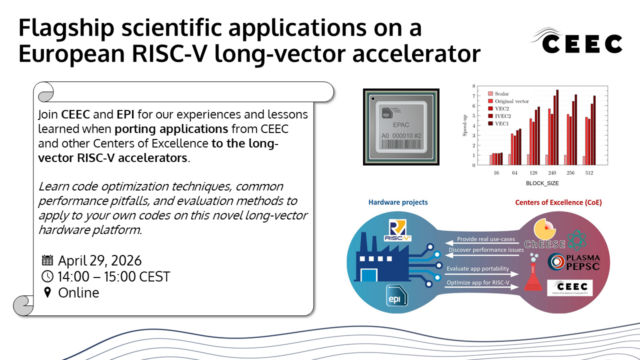

  • Flagship scientific applications on a European RISC-V long-vector accelerator: Lessons learned

    Online

    As Europe accelerates its efforts in chip sovereignty, scientific applications need to be ported to and evaluated on emerging prototypes, assessing their performance as well as the technology readiness of the new hardware platforms. In this talk, we will share the experiences and lessons learned when porting applications from CEEC and other Centers of Excellence […]

  • Enabling mixed-precision with VerifiCarlo: Sharing CEEC experience

    Join our own Roman Iakymchuk, Umeå University on behalf of CEEC, and Pablo de Oliveira Castro, Université Paris-Saclay UVSQ, for our next webinar on mixed precision and VerifiCarlo!

    In this webinar, we will introduce Verificarlo, showcase its backends for numerical bug detection and mixed-precision analysis, and present a success story highlighting the road from analysis of codes with Verificarlo to reliable mixed-precision codes.

  • Extreme-Scale High-Fidelity Computational Fluid Dynamics with Neko

    Neko is a portable framework for high-order spectral element-based simulations, focusing primarily on incompressible and compressible fluid flows. Written using a modern object-oriented approach, the framework supports a wide range of hardware backends, including general-purpose processors, accelerators, and vector processors. Neko has demonstrated excellent performance and scalability across various hardware architectures and was nominated as […]